Zum Inhalt springen
🎉 Limited time: Save the 199€ setup fee - register now! Save now

Guide

Your comprehensive knowledge hub for psychological risk assessment: Legal requirements, proven methods and practical guides.

Featured

Psychological Risk Assessment: The Complete Guide 2026

Everything about psychological risk assessment: Legal requirements, 7-step guide, method comparison and practical tips for implementation.

15 min read

Explore Topics

Core Topics

Core Topics

7 min read

Phased return to work (German "stufenweise Wiedereingliederung") explained: legal basis (§74 SGB V, §44 SGB IX), process, step plan, pay & sick benefits, difference from BEM – and how employers prevent long absences.

TL;DR

Phased reintegration ("Hamburger Modell") gradually returns long-term sick employees to full duties – they remain officially unfit for work during the measure

P
Patrick Kutzer


Read more →
8 min read

German BEM (betriebliches Eingliederungsmanagement, §167 (2) SGB IX) explained: when it is mandatory, how the BEM meeting works, employee rights, data protection – and its link to dismissal law and mental health.

TL;DR

BEM is mandatory for employers: anyone unfit for work for more than six weeks within 12 months must be offered a BEM (§167 (2) SGB IX)

R
Rainer Orthober
Read more →
7 min read

German workplace health management (BGM) explained: definition, the three pillars (occupational safety, BEM, health promotion), BGM vs BGF, building blocks, a 5-step rollout and the legally mandatory core – the psychological risk assessment.

TL;DR

BGM is the strategic framework bundling all health-related activities; it rests on three pillars: occupational safety, company integration management (BEM) and workplace health promotion (BGF)

P
Patrick Kutzer
Read more →
7 min read

German continued remuneration during illness explained: 6 weeks of full pay under §3 EFZG, conditions, amount, what applies after 6 weeks (sick pay), the "same illness" rule and notification duties – plus the link to mental illness.

TL;DR

During incapacity the employer continues full pay for up to 6 weeks (42 calendar days) – legal basis §3 EFZG

R
Rainer Orthober
Read more →
6 min read

Burnout prevention for employers: what burnout is, the warning signs, the difference between conditions-based and behaviour-based prevention, and which measures work – with the psychological risk assessment as the systematic prevention tool.

TL;DR

Burnout results from chronic workplace stress (ICD-11: QD85) – the most effective prevention targets working conditions, not just the individual

P
Patrick Kutzer
Read more →
7 min read

Illness-related dismissal explained: the three BAG conditions (negative health prognosis, operational impact, balancing of interests), the role of BEM, dismissal protection – and how prevention avoids such cases.

TL;DR

Illness-related dismissal is a sub-type of person-related dismissal and only valid under strict conditions

R
Rainer Orthober
Read more →
7 min read

Incapacity for work in Germany explained: definition, sick notes and the electronic AU (eAU), notification and proof duties, duration with continued pay and sick pay – and why mental illness causes the longest absences.

TL;DR

Incapacity for work (AU) exists when an employee cannot perform their last activity due to illness, or only at the risk of worsening their condition

P
Patrick Kutzer
Read more →
6 min read

Employee retention explained: why it is decisive amid skills shortages, the key retention factors, concrete measures – and why mental health and healthy leadership are the underrated lever.

TL;DR

Retention lowers turnover costs (often several monthly salaries per departure) and preserves know-how

P
Patrick Kutzer
Read more →
6 min read

The German return-to-work interview explained: what it is, the difference from the legally required BEM, a fair process, what is allowed and what is taboo (data protection) – and why prevention beats control.

TL;DR

The return-to-work interview is a voluntary, informal conversation after an illness – it has no legal basis of its own

R
Rainer Orthober
Read more →
Wirksamkeitskontrolle Gefährdungsbeurteilung
6 min read

How do you verify the effectiveness of your psychological risk assessment? Methods, timing, legal requirements and a practical checklist for effectiveness reviews.

TL;DR

Effectiveness review is legally required under §3 ArbSchG – not an optional extra

P
Patrick Kutzer
Read more →
Psychische Belastung Statistiken 2026
8 min read

Current statistics on psychological stress at the workplace in Germany 2026: DAK, BKK, BAuA, BIBB/BAuA survey. Facts on burnout, sick days and economic costs.

TL;DR

11.4% of all sick days are due to mental health conditions (BKK Health Report 2024)

P
Patrick Kutzer
Read more →
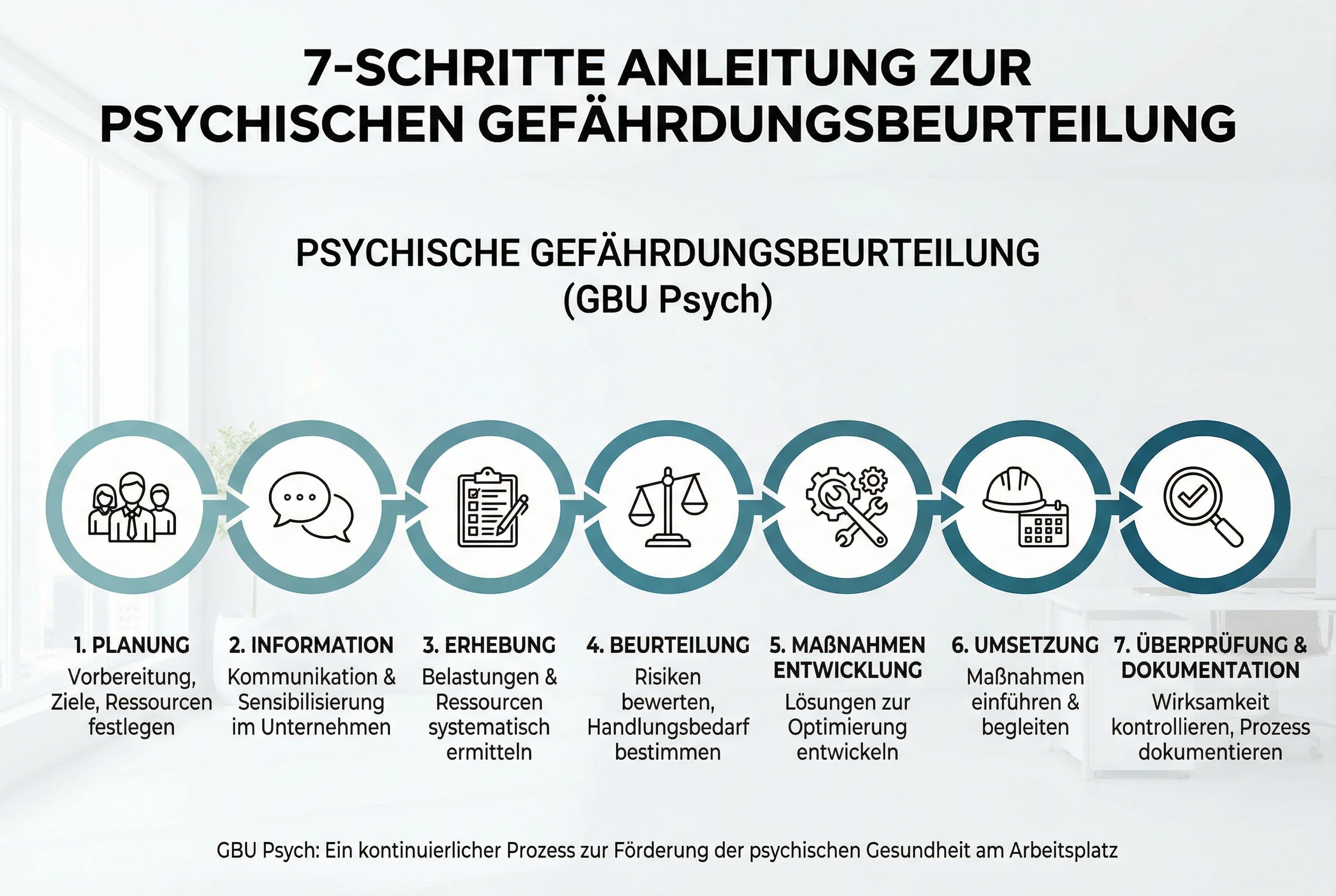
Mitarbeiter bei der Durchführung einer psychischen Gefährdungsbeurteilung
15 min read

Everything about psychological risk assessment: Legal requirements, 7-step guide, method comparison and practical tips for implementation.

TL;DR

Psychological risk assessment has been mandatory for all employers in Germany since 2013

P
Patrick Kutzer
Read more →
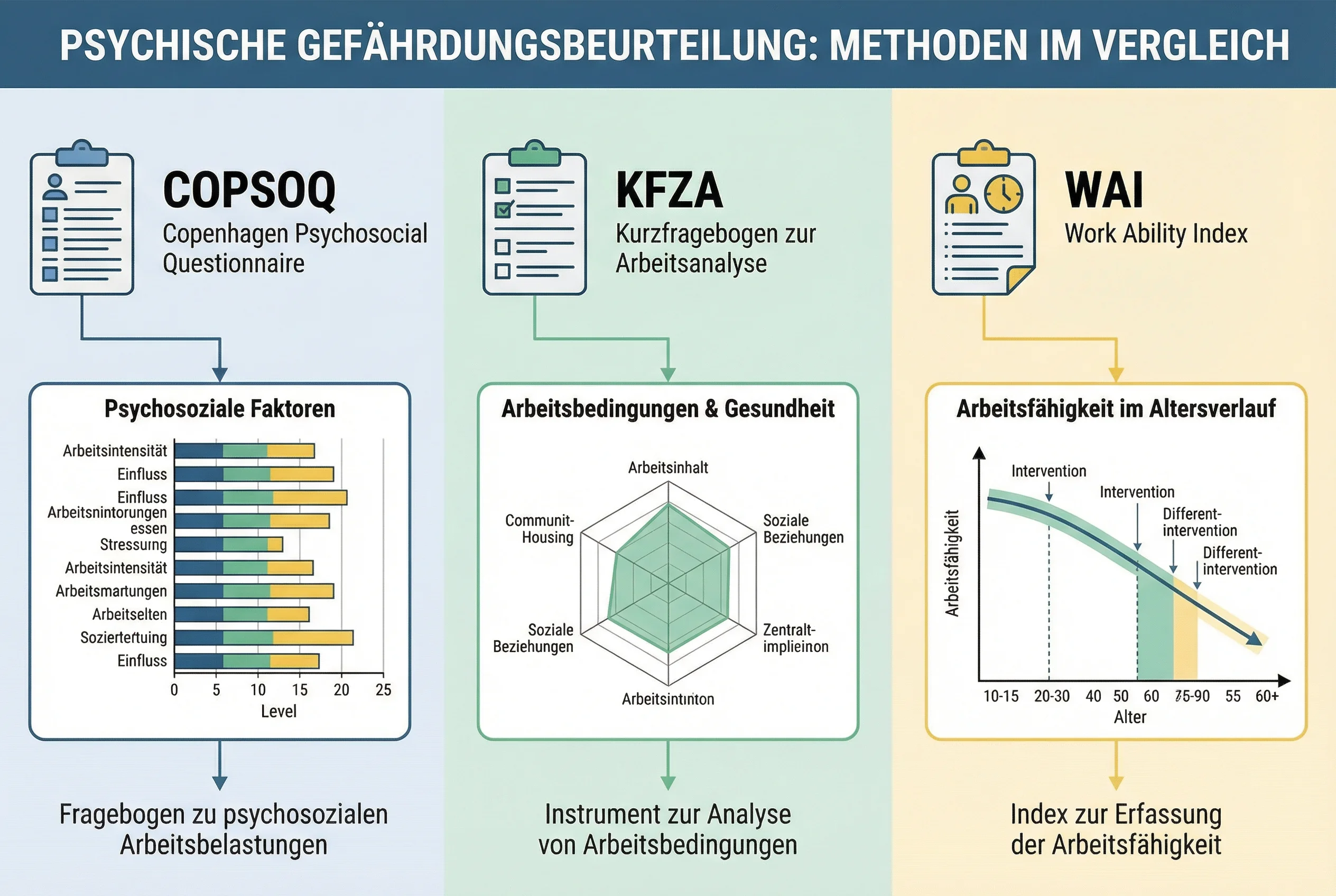
Vergleich verschiedener Methoden zur Erfassung psychischer Belastung
10 min read

5 scientifically validated methods for assessing psychological stress: COPSOQ, KFZA, WAI, interviews and workshops compared.

TL;DR

There are five main methods for assessing psychological stress: questionnaires (COPSOQ, KFZA), WAI, interviews and workshops

P
Patrick Kutzer
Read more →
Beispiele für Maßnahmen aus der psychischen Gefährdungsbeurteilung
11 min read

Concrete examples of measures for psychological risk assessment: From quick wins to strategic initiatives following the TOP principle.

TL;DR

Measures should be prioritized according to TOP principle (Technical > Organizational > Personal)

P
Patrick Kutzer
Read more →
Target Groups

Target Groups

Industries & Scenarios

Industries & Scenarios

Best Practices

Best Practices

Team bei der Analyse von Befragungsergebnissen
11 min read

How to properly analyze psychological risk assessment results: Understanding metrics, identifying critical areas and deriving effective measures.

TL;DR

Analysis is the crucial step between survey and measures

P
Patrick Kutzer
Read more →