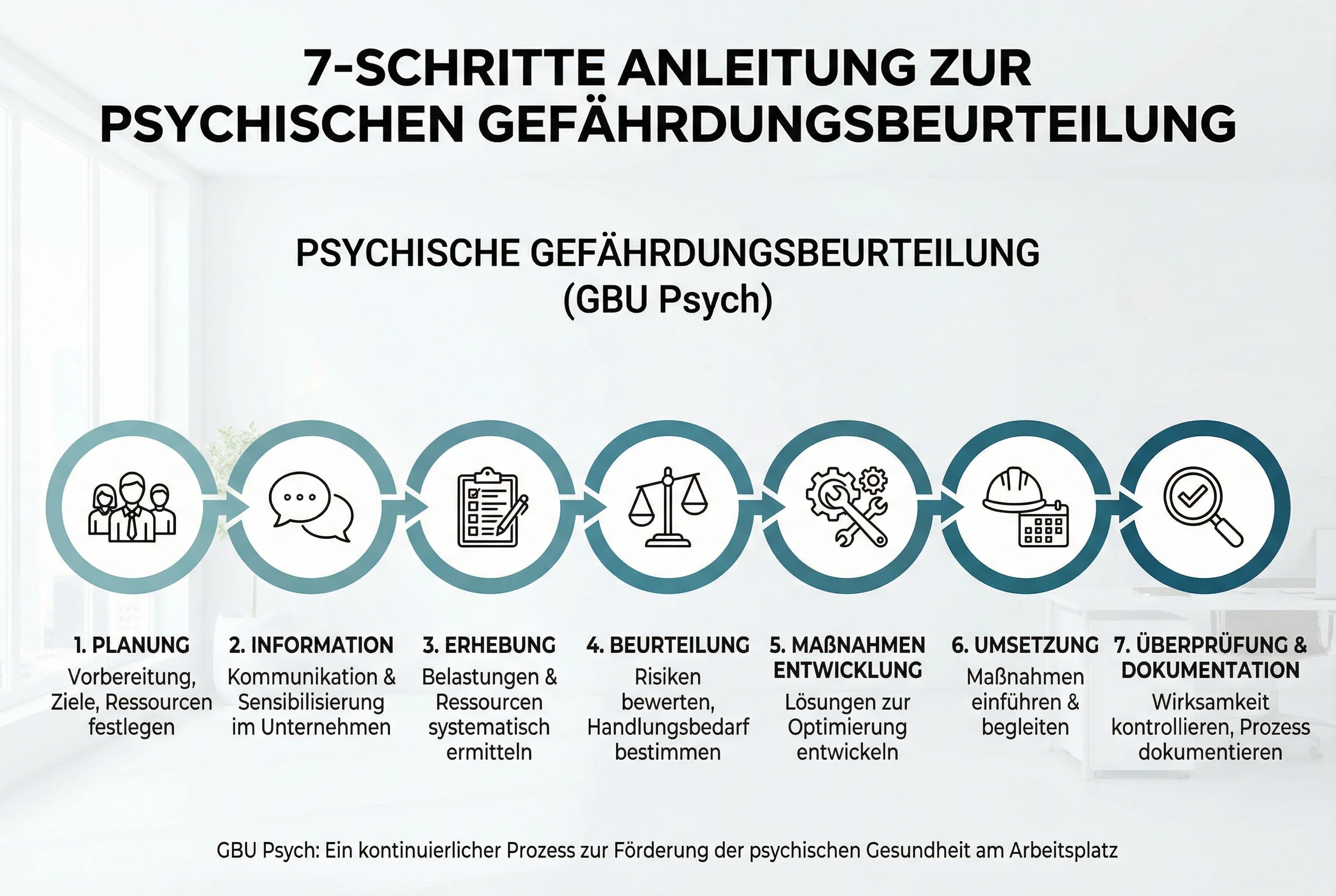
Overview: The 7 Steps of Psychological Risk Assessment
Psychological risk assessment follows a structured process. The seven-step outline below is oriented on the recommendations of the GDA (Joint German Occupational Safety Strategy), but it is our practical rendering and not a verbatim reproduction of a GDA document:
- Preparation and planning
- Define activities and areas
- Identify psychological stressors
- Evaluate stressors
- Develop measures
- Implement measures
- Review effectiveness
Step 1: Preparation and Planning
Thorough preparation is the foundation of a successful risk assessment.
Clarify Responsibilities
- Appoint project lead: Who coordinates the process?
- Form steering group: HR, occupational safety, works council, managers
- External support: Is a service provider needed?
Select Method
Choose an appropriate assessment method:
- Questionnaire: Ideal for larger groups, anonymous, easy to evaluate
- Interviews: In-depth but time-consuming
- Workshops: Participatory, good for developing measures
Create Timeline
- Plan realistic timeframes for each step
- Include buffer times
- Define milestones
Prepare Communication
- Inform employees early
- Explain objectives and process
- Assure anonymity (for surveys)
Step 2: Define Activities and Areas
Not every single workplace needs to be examined separately. Group similar activities together.
Criteria for Grouping
- Similar work tasks
- Comparable work organization
- Similar work environment
- Comparable social situation
Examples of Activity Groups
- Back office administration
- Field sales
- Production shift work
- Middle management
- Phone customer service
Practical Tip
As a rule of thumb from practice, not a requirement: for SMEs 3-5 activity groups are often sufficient. Larger companies need more differentiation accordingly.
Step 3: Identify Psychological Stressors
Now the actual data collection takes place. When using a questionnaire (recommended), proceed as follows:
Prepare Survey
- Set the survey period (practice recommendation: at least 2 weeks; there is no normative requirement)
- Invite participants (via email, in person, notice board)
- Check technical requirements
Conduct Survey
- Send reminders
- Monitor response rate
- Extend period if necessary
Response Rate
There is no statutory or normative minimum response rate: neither the GDA guideline nor the BAuA risk-assessment handbook nor DGUV Information 206-026 names a threshold. The higher the response, the more robust the finding per activity group. What matters just as much is that every activity group is reached, not only some areas.
Step 4: Evaluate Stressors
The collected data must now be analyzed and interpreted.
Analysis
- Prepare results per activity group
- Analyze averages and distributions
- Compare with benchmark data
Identify Critical Areas
Areas considered critical are those that:
- Deviate significantly from benchmark
- Exceed the threshold of the instrument in use. That threshold depends on the instrument: the Prüfliste Psychische Belastung of the Unfallversicherung Bund und Bahn sets it at more than 50% "rather no" answers, BASA II at 20% or more (action recommended) and 30% or more (action urgent). Source: DGUV Information 206-026, August 2019
- Have worsened since the last assessment
Communicate Results
- Inform steering group
- Involve managers
- Inform employees about overall results
Step 5: Develop Measures
Concrete measures are now developed for identified problem areas.
Apply TOP Principle
Measures should be prioritized according to the TOP principle:
- Technical measures (e.g., better equipment, reduce noise)
- Organizational measures (e.g., optimize workflows, clear responsibilities)
- Personal measures (e.g., training, coaching)
Specify Measures
Each measure should include:
- Concrete description
- Responsible person
- Implementation deadline
- Required resources
Use Workshops
Facilitated workshops with affected employees are ideal for developing practical and accepted measures.
Step 6: Implement Measures
The agreed measures must now be consistently implemented.
Create Implementation Plan
- Set priorities (quick wins vs. long-term projects)
- Define milestones
- Provide resources
Track Progress
- Regular status meetings
- Document progress
- Identify and remove obstacles
Communication
- Inform employees about ongoing measures
- Make successes visible
- Gather feedback
Step 7: Review Effectiveness
The process is only complete when the effectiveness of measures has been reviewed.
Timing of Review
Effectiveness review should occur:
- After completion of measure implementation
- After an appropriate interval. § 3 (1) ArbSchG requires the review but names no deadline; 6-12 months is our practice recommendation
- At the latest during the next regular assessment
Review Methods
- Follow-up survey with same questions
- Compare metrics (sick leave, turnover)
- Feedback conversations with employees
Document Results
Documentation must include:
- Were measures fully implemented?
- Are measures showing effect?
- Are adjustments or additional measures needed?
Conclusion and Next Steps
Psychological risk assessment is a continuous process. After completing one cycle, planning for the next begins. With SafeMind, you have all steps in view and are automatically reminded of due updates.