Why Standardized Methods are Important
Assessing psychological stress in the workplace requires scientifically validated methods. Only then can you:
- Achieve objective and comparable results
- Measure changes over time
- Ensure legally compliant documentation
- Benchmark against other companies
The Joint German Occupational Safety and Health Strategy (GDA) explicitly recommends using recognized methods for psychological risk assessment.
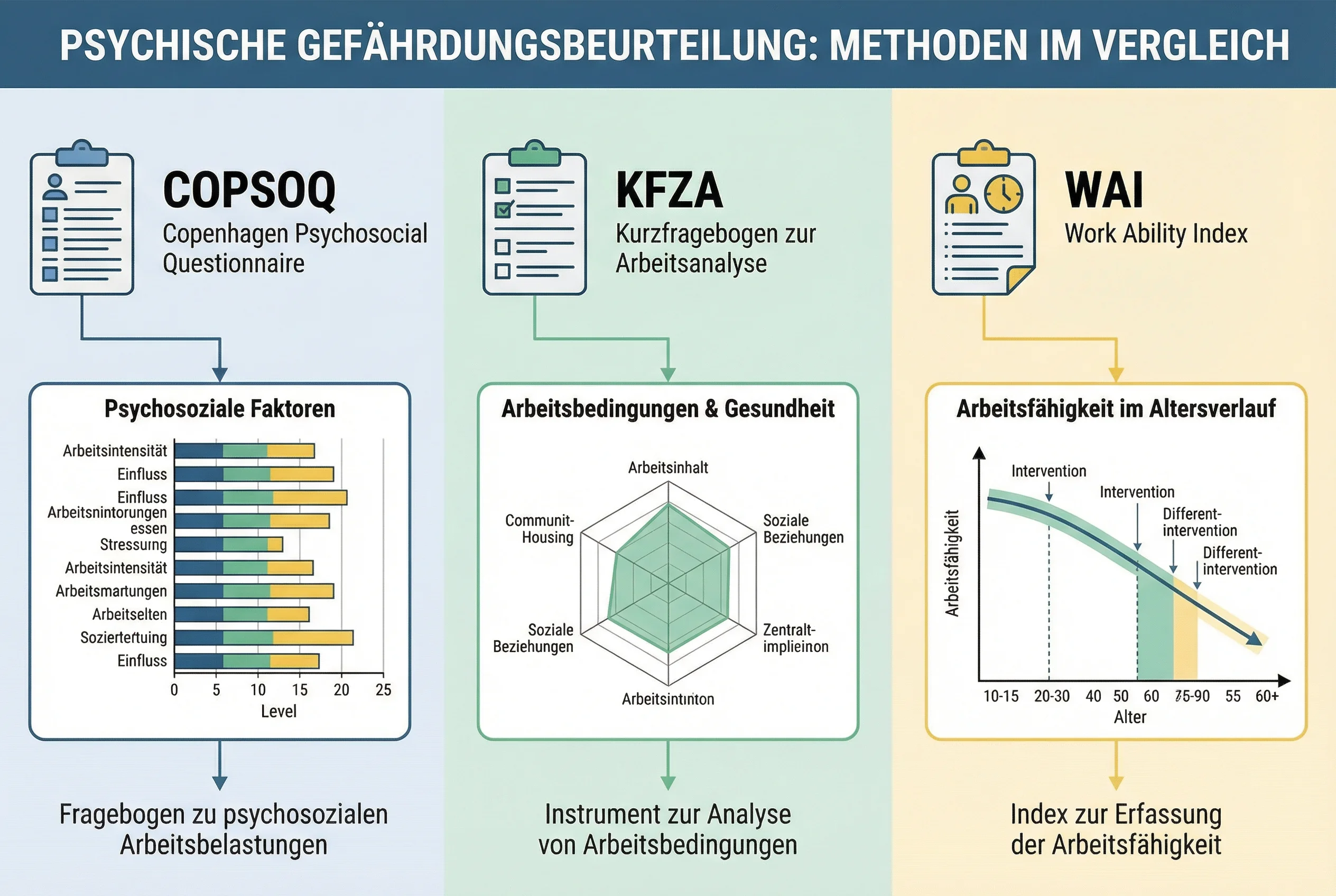
Method 1: COPSOQ (Copenhagen Psychosocial Questionnaire)
The COPSOQ is one of the most widely used questionnaires worldwide for assessing psychosocial factors in the workplace.
Structure
The German standard version of COPSOQ III comprises 84 items across 31 scales. COPSOQ Germany does not offer a short or long version; the earlier tiering from COPSOQ II is obsolete.
Dimensions Covered
The COPSOQ assesses, among others:
- Demands (quantitative, emotional, cognitive)
- Influence and development opportunities
- Social relationships and leadership
- Job insecurity
- Health and well-being
Advantages of COPSOQ
- Scientifically validated and internationally recognized
- Extensive benchmark database available
- The questionnaire itself is licensed under CC BY-NC-ND 4.0: usable without a licence fee, but not open source, not modifiable and not for commercial use
Cost: running a survey through COPSOQ Germany is chargeable and starts at 1,200 euros for up to 50 people. SafeMind does not use COPSOQ; it uses its own questionnaire along the six GDA assessment areas.
Method 2: KFZA (Short Questionnaire for Work Analysis)
The KFZA is a compact questionnaire developed specifically for workplace practice.
Structure
With only 26 questions, the KFZA captures the most important stress factors in a short time. It is particularly suitable for:
- Quick initial assessments
- Small and medium-sized enterprises
- Regular brief surveys
Areas Covered
- Scope for action
- Variety
- Completeness
- Social support
- Cooperation
- Qualitative workload
- Quantitative workload
- Work interruptions
- Environmental stressors
- Information and participation
- Company benefits
Method 3: WAI (Work Ability Index)
The Work Ability Index measures employees' subjectively perceived work ability.
Special Feature
Unlike COPSOQ and KFZA, the WAI doesn't focus on individual stress factors but on the resulting work ability. It evaluates:
- Current work ability compared to best ever achieved
- Work ability in relation to job demands
- Number of current illnesses diagnosed by a doctor
- Estimated impairment of work performance caused by those illnesses
- Sick leave in the past year
- Own estimate of work ability two years from now
- Mental performance reserves
Source for the seven dimensions: BAuA, Praxis series A51 (Work Ability Index).
Application Area
The WAI is particularly suitable for:
- Workplace health management
- Age-appropriate work design
- Long-term studies on work ability
Method 4: Guided Interviews
This method involves conducting structured individual conversations with employees.
Implementation
A trained interviewer conducts conversations based on a prepared guide. Typical topics:
- Work tasks and requirements
- Work equipment and environment
- Work organization and working hours
- Social relationships
- Stressors and resources
Advantages and Disadvantages
Advantages:
- In-depth qualitative information
- Individual follow-up questions possible
- High acceptance among employees
Disadvantages:
- High time and resource investment
- No anonymity possible
- Difficult to quantify results
- Requires trained interviewers
Method 5: Facilitated Workshops (Analysis Workshops)
This method involves conducting group workshops with employees.
Process
As a rule of thumb from practice, not a requirement: typically 6-12 employees from similar activity areas participate. The workshop includes:
- Introduction and goal explanation
- Collection of stress factors (e.g., using card queries)
- Evaluation and prioritization
- Development of measure proposals
- Documentation of results
Advantages and Disadvantages
Advantages:
- Direct involvement of employees
- Team-based measure development
- High acceptance of results
- Quick identification of action areas
Disadvantages:
- Group dynamics can influence results
- No anonymity
- Requires experienced facilitation
- Difficult for sensitive topics
Method Comparison: Which Method for Which Purpose?
| Criterion | Questionnaire | Interview | Workshop |
|---|---|---|---|
| Anonymity | High | None | None |
| Time required | Low | High | Medium |
| Cost | Low | High | Medium |
| Quantifiability | High | Low | Medium |
| Depth | Medium | High | Medium |
| Comparability | High | Low | Low |
Our Recommendation
For most companies, we recommend a combination of standardized questionnaire and supplementary workshops:
- Questionnaire for broad, anonymous assessment
- Workshops for deeper exploration of critical areas and measure development
SafeMind combines a structured questionnaire covering all 6 GDA areas with automatic evaluation, giving you an efficient tool for a legally compliant psychological risk assessment.