
What is a Psychological Risk Assessment?
A psychological risk assessment (German: psychische Gefährdungsbeurteilung or GB Psych) is a systematic procedure for identifying and evaluating psychological stressors in the workplace. It is part of the general risk assessment under the German Occupational Health and Safety Act (ArbSchG) and has been explicitly required by law since 2013.
Unlike the assessment of physical hazards, the psychological risk assessment focuses on working conditions that can affect employees' mental health. These include, for example:
- Work intensity and time pressure
- Scope for action and decision-making freedom
- Social relationships in the workplace
- Work environment (noise, lighting, room climate)
- Working hours and work-life balance
Important: The psychological risk assessment does not capture individual mental illnesses or personal problems of employees. It is exclusively about the working conditions themselves.
Legal Requirements: Why is the Assessment Mandatory?
The legal basis for psychological risk assessment is found in the German Occupational Health and Safety Act (ArbSchG):
§ 5 ArbSchG - Assessment of Working Conditions
Since the 2013 amendment, § 5 para. 3 no. 6 ArbSchG explicitly mentions "psychological stress at work" as a risk factor to be considered. This means:
- Every employer is required to assess psychological stress
- There are no exceptions based on company size or industry
- The obligation applies from the first employee
§ 6 ArbSchG - Documentation Requirement
The documentation requirement under § 6 (1) ArbSchG applies regardless of the number of employees. The type of activities and the number of employees determine how extensive the records must be, not whether records are required at all. The documentation must include:
- The result of the risk assessment
- The defined occupational health and safety measures
- The result of the review (effectiveness check)
Consequences of Non-Compliance
A missing risk assessment does not trigger a fine directly. The consequences build up in stages:
- Order by the supervisory authority: the authority records the deficiency and orders remediation within a reasonable deadline under § 22 (3) ArbSchG. If the order is not met, it can prohibit the affected work.
- Fine up to 30,000 euros: only a breach of such an enforceable order is an administrative offence under § 25 (1) no. 2 (a) ArbSchG. The 30,000 euro maximum follows from § 25 (2) ArbSchG; in all other cases the maximum is 5,000 euros.
- Personal liability towards employees only where the insured event was caused intentionally or on an insured commute (§ 104 (1) SGB VII)
- Recourse claims by the accident insurance institutions only in case of intent or gross negligence (§ 110 (1) SGB VII)
- Criminal liability under § 26 ArbSchG where such a breach is persistently repeated, or where it intentionally endangers the life or health of an employee
Inspections from 2026: Stricter Controls
The Joint German Occupational Safety and Health Strategy (GDA) runs psychological stress as one of three work programmes in its current strategy period. The GDA dates that period inconsistently in its own publications, so no years are given here. The tightening from 2026 follows from the law: under § 21 (1a) ArbSchG, starting with the 2026 calendar year the federal states must inspect at least 5 percent of the establishments present in the state each year. This means:
- Increased inspections by trade supervisory authorities and employer's liability insurance associations
- Standardized inspection procedures for psychological risk assessments
- An unchanged fine range that still requires a breach of an enforceable order under § 22 (3) ArbSchG
The GDA report on the business and employee survey 2023/24 (published by the NAK office at the BAuA; 3,817 businesses, business-survey fieldwork September 2023 to March 2024) reports two rates: 68 % of all businesses run a risk assessment (2015: 52 %), and 65 % of the businesses that run one also cover mental load. The survey does not report a rate for the share of all businesses holding a GB Psych. Authorities will increasingly verify implementation in the coming years.
The 7 Steps of Psychological Risk Assessment
Conducting a psychological risk assessment follows a structured process with seven steps:
Step 1: Preparation and Planning
Before starting, you should clarify the following questions:
- Who is responsible for conducting the assessment?
- Which method will be used (questionnaire, interviews, workshops)?
- How will the works council be involved?
- What budget and timeframe are available?
Step 2: Define Activities/Areas
Identify similar activity groups in your company. Not every individual workplace needs to be considered separately - comparable activities can be grouped together.
Step 3: Identify Psychological Stressors
Psychological stressors can be identified through various methods:
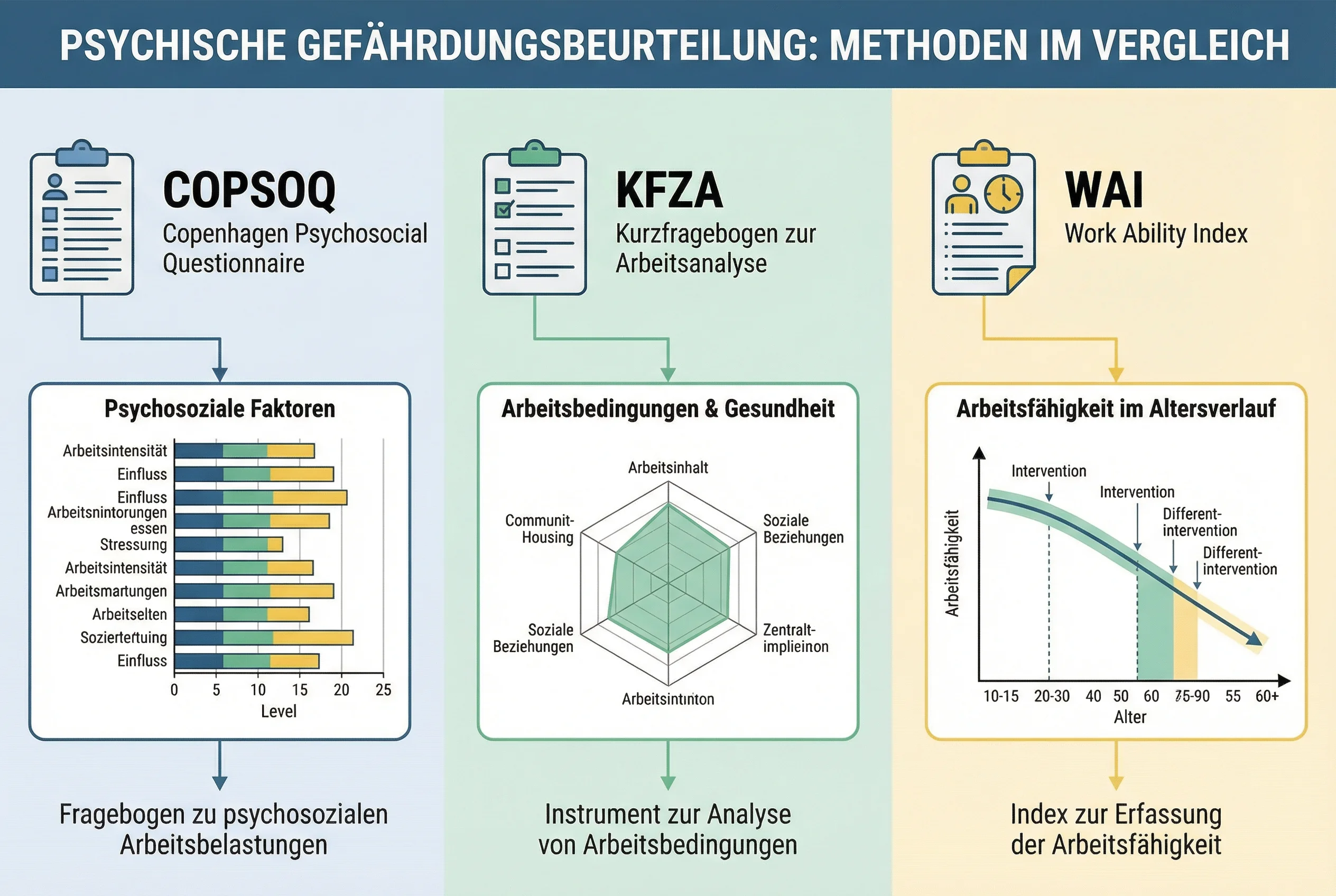
- Standardized questionnaires (e.g., COPSOQ, KFZA)
- Employee interviews
- Facilitated workshops
- Observation methods
Step 4: Evaluate Stressors
The identified stressors are evaluated. Results are compared with reference values or benchmarks to identify critical areas.
Step 5: Develop Measures
For identified problem areas, measures are developed according to the TOP principle:
- Technical measures (e.g., better work equipment)
- Organizational measures (e.g., process optimization)
- Personal measures (e.g., training)
Step 6: Implement Measures
The agreed measures are implemented with clear responsibilities and deadlines.
Step 7: Review Effectiveness
After an appropriate period, it is checked whether the measures are having the desired effect. Adjustments are made if necessary.
Method Comparison: Questionnaire, Interview, or Workshop?
There are various recognized methods for conducting a psychological risk assessment. Each has its advantages and disadvantages:
Standardized Questionnaires
Advantages:
- Anonymous participation possible
- Quantitative, comparable results
- Low time investment per employee
- Scientifically validated
Disadvantages:
- Less depth on individual topics
- No individual follow-up questions possible
Guided Interviews
Advantages:
- In-depth information
- Individual follow-up questions possible
- High acceptance among employees
Disadvantages:
- High time investment
- No anonymity
- Requires trained interviewers
Facilitated Workshops
Advantages:
- Direct involvement of employees
- Team-based measure development
- High acceptance of results
Disadvantages:
- Group dynamics can influence results
- Not suitable for all topics
- Requires experienced facilitation
Common Mistakes in Psychological Risk Assessment – And How to Avoid Them
The same mistakes are repeatedly made when conducting psychological risk assessments:
Mistake 1: No or Insufficient Documentation
Problem: Results are not documented or only incompletely documented.
Solution: Use structured documentation that records all steps in a traceable manner. Digital solutions like SafeMind automatically create legally compliant records.
Mistake 2: One-Time Implementation Without Updates
Problem: The assessment is conducted once and then forgotten.
Solution: the risk assessment must be adapted when working conditions change significantly and reviewed at appropriate intervals (§ 3 (1) ArbSchG). There is no statutory interval; a two to three year cycle is a practice recommendation.
Mistake 3: Failure to Involve the Works Council
Problem: The works council is not involved or involved too late.
Solution: Involve the works council from the beginning. They have co-determination rights under § 87 BetrVG on health protection matters.
Mistake 4: No Measures Derived from Results
Problem: Stressors are identified, but no concrete measures follow.
Solution: Develop at least one concrete measure with responsibility and deadline for each identified problem area.
Digital Solutions: Implementing Psychological Risk Assessment Efficiently
Modern digital solutions like SafeMind significantly simplify conducting psychological risk assessments:
- Quick setup: Create a survey in minutes
- Barrier-free participation: Available in 15+ languages
- Automatic evaluation: Results immediately available with benchmarking
- Legally compliant documentation: Certificates with timestamps
- Measure tracking: Integrated tool for implementation monitoring
Conclusion: Act Now
Psychological risk assessment is not only a legal obligation but also an important tool for improving working conditions and employee satisfaction. With the right approach and appropriate tools, it can be implemented efficiently and in compliance with regulations.
The statutory minimum inspection rate of 5 percent from 2026 (§ 21 (1a) ArbSchG) makes it clear: anyone who has not yet conducted a psychological risk assessment should act quickly.