Is Psychological Risk Assessment Mandatory?
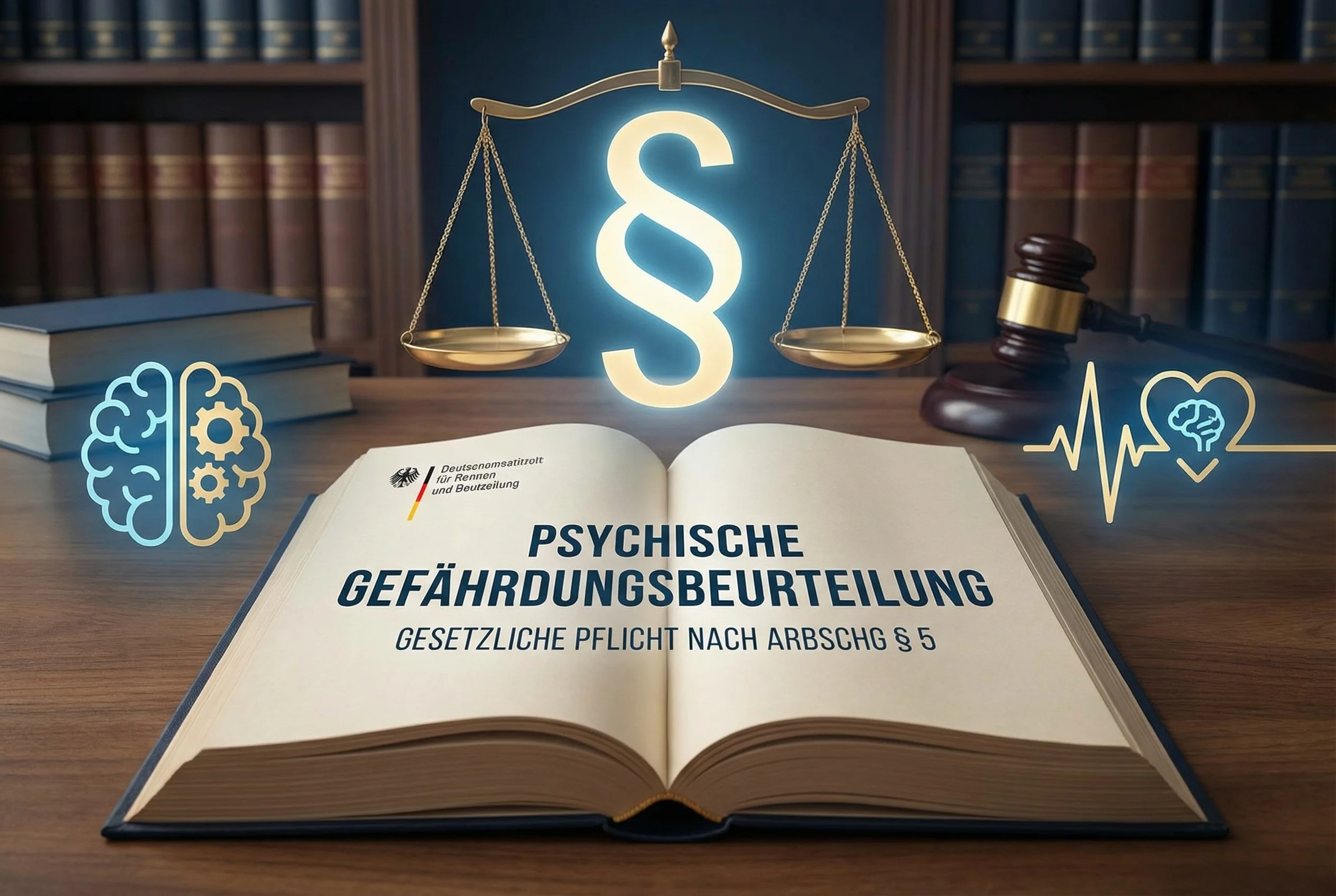
Yes, psychological risk assessment is legally mandatory for all employers in Germany.
Many business owners ask this question, and the answer is clear: Since the amendment to the German Occupational Health and Safety Act in 2013, employers must systematically identify and evaluate psychological stress in the workplace.
The Legal Basis
The obligation derives from § 5 para. 3 no. 6 of the German Occupational Health and Safety Act (ArbSchG):
"A hazard may arise in particular from [...] psychological stress at work."
This 2013 amendment was a response to the sharp increase in mental health issues in the workplace. The legislature made clear: Psychological stressors must be taken just as seriously as physical hazards.
Who Does the Obligation Apply To?
The obligation for psychological risk assessment applies to:
- All employers – regardless of company size
- All industries – from craft businesses to corporations
- From the first employee – there are no minimum thresholds
- For all workplaces – office, production, mobile work
No Exceptions
Unlike some other employment law regulations, there are no exceptions for small businesses when it comes to psychological risk assessment. Even a company with just one employee must assess psychological stressors.
The documentation requirement under § 6 (1) ArbSchG applies regardless of headcount too. The type of activities and the number of employees only determine how extensive the records must be. A small business can keep its documentation brief, but cannot skip it.
What Penalties Apply for Violations?
Failure to conduct psychological risk assessment can have serious consequences:
Fines under § 25 ArbSchG
A missing risk assessment is not in itself an administrative offence. The supervisory authority records the deficiency and orders remediation within a reasonable deadline under § 22 (3) ArbSchG. Only a breach of that enforceable order carries a fine:
- Up to €30,000 for breaching an enforceable order under § 22 (3) ArbSchG (§ 25 (1) no. 2 (a) in conjunction with § 25 (2) ArbSchG)
- Up to €5,000 in the other cases covered by § 25 (1) ArbSchG
- If the employer does not comply with the order, the authority can additionally prohibit the affected work (§ 22 (3) ArbSchG)
Personal Liability
Personal liability of management is narrower than it is often presented. The statutory accident insurance largely shields employers and colleagues:
- Civil liability towards employees only arises where the insured event was caused intentionally or on an insured commute (§ 104 (1) SGB VII). A missing risk assessment alone does not trigger it.
- Recourse claims by the accident insurance institutions require intent or gross negligence (§ 110 (1) SGB VII).
- Criminal consequences under § 26 ArbSchG for persistent repetition or intentional endangerment.
Criminal Liability under § 26 ArbSchG
§ 26 ArbSchG builds on the administrative offence under § 25 (1) no. 2 (a) ArbSchG. Criminal liability attaches to anyone who persistently repeats a breach of an enforceable order by the supervisory authority, or who through such an act intentionally endangers the life or health of an employee. Penalties include imprisonment up to one year or fines.
Inspections from 2026: Increased Scrutiny
The Joint German Occupational Safety and Health Strategy (GDA) runs psychological stress as one of three work programmes in its current strategy period. The GDA dates that period inconsistently in its own publications, so no years are given here.
The increase in inspections from 2026 does not follow from the GDA but from the law: under § 21 (1a) ArbSchG, starting with the 2026 calendar year the federal states must inspect at least 5 percent of the establishments present in the state each year (minimum inspection rate).
What This Means for Companies
- More inspections: Trade supervisory authorities and insurance associations are increasing checks
- Standardized inspection procedures: Uniform checklists for checking risk assessments
- The order procedure still comes first: a fine still requires a breach of an enforceable order under § 22 (3) ArbSchG. The authority records the deficiency and sets a deadline before any fine.
Current Statistics
The GDA report on the business and employee survey 2023/24 (published by the NAK office at the BAuA; 3,817 businesses, business-survey fieldwork September 2023 to March 2024) reports two rates: 68 % of all businesses run a risk assessment (2015: 52 %), and 65 % of the businesses that run one also cover mental load. By size: micro businesses with up to 9 employees 61 % (2015: 42 %), businesses with 10 to 49 employees 85 % (2015: 71 %). Older inspection data use a different reference population: 47.4 % of the roughly 13,000 businesses visited in the GDA Psyche programme 2013 to 2018 had no risk assessment of mental load; the 12,975 records in the closing report are inspection records, not unambiguously individual businesses. Those businesses are not a random sample.
What is Checked During Inspections?
Inspectors look for the following during controls:
1. Implementation
- Was a psychological risk assessment conducted?
- Were all relevant activity areas covered?
- Was a recognized method used?
2. Documentation
- Is there written documentation?
- Does it contain all required content?
- Is the documentation current?
3. Measures
- Were measures derived from the results?
- Were the measures implemented?
- Was effectiveness reviewed?
4. Participation
- Was the works council involved (if applicable)?
- Were employees informed?
How to Fulfill Your Obligations
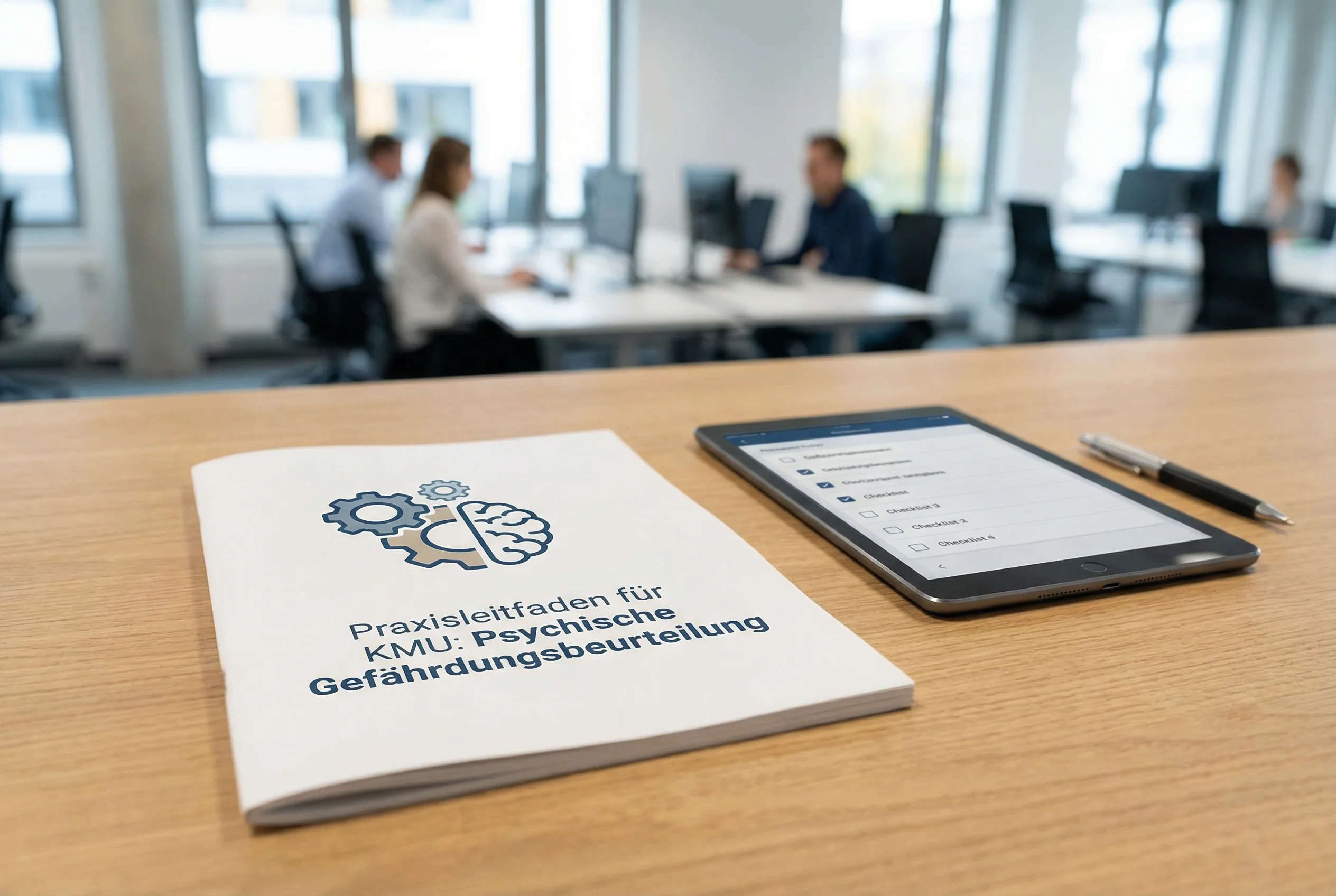
The good news: With the right approach, fulfilling legal obligations is achievable:
Step 1: Choose a Method
Select a recognized method such as standardized questionnaires (e.g., COPSOQ), interviews, or workshops.
Step 2: Define Activity Areas
Group similar activities together. You don't need to examine each individual workplace separately.
Step 3: Assess Stressors
Conduct the survey or analysis. With digital tools like SafeMind, this can be done quickly and anonymously.
Step 4: Document
Record results, measures, and effectiveness reviews in writing.
Step 5: Implement Measures
Develop and implement improvements for identified problem areas.
Step 6: Update Regularly
Repeat the assessment when significant changes occur and at least every 2-3 years.
Conclusion: Act Now Instead of Waiting
Psychological risk assessment is not optional – it's a legal requirement. The increased inspections from 2026 make clear: Those who haven't yet conducted an assessment should wait no longer.
With SafeMind, you can fulfill your obligations quickly, efficiently, and in compliance with regulations – while also improving working conditions for your employees.